The Temple of Artemis
Built in the late 6th century BCE, destroyed by the Persians, and rebuilt in the 420s BCE. A modest Doric building with four columns in the inner chamber and an adyton, a restricted back room, behind it.
Βραυρώνα · ancient Brauron
Artemis was worshipped here for five centuries, and small girls served her dressed as bears.
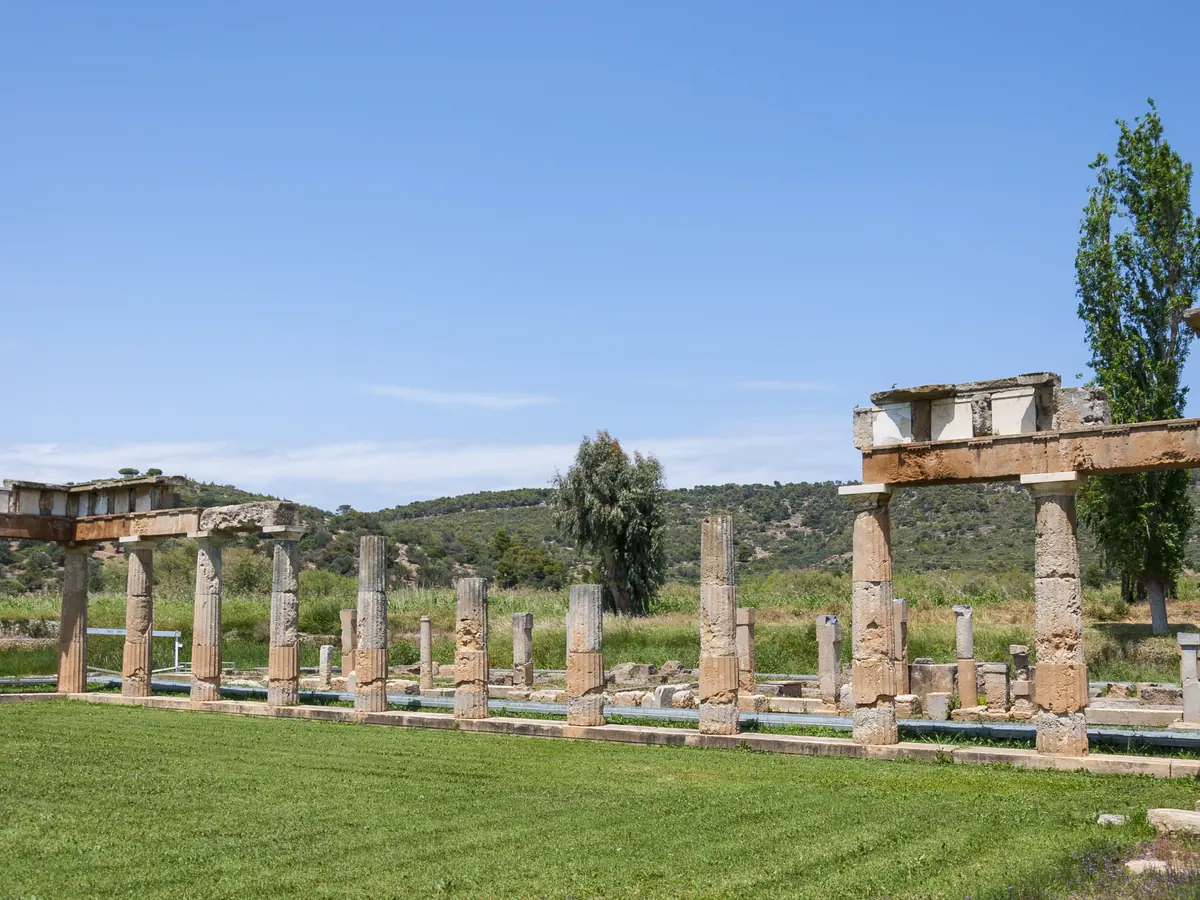 Photo by Ava Babili, CC BY-SA 4.0, cropped
Brauron was one of the twelve settlements of Attica before Theseus gathered them into Athens. It is a short drive inland from Rafina, and it is the most substantial ancient site anywhere near the port.
Schematic. Drawn from the recorded dimensions rather than surveyed, so treat the layout as indicative and the measurements as the reliable part.
More than most Attic sites, and one thing you cannot see anywhere else in the country.
Built in the late 6th century BCE, destroyed by the Persians, and rebuilt in the 420s BCE. A modest Doric building with four columns in the inner chamber and an adyton, a restricted back room, behind it.
A colonnade wrapping three sides of a courtyard of 20 by 27 metres, containing nine dining rooms. Each still has the cuttings in the floor that positioned eleven dining couches, so you can count the places at a meal eaten 2,400 years ago.
A Classical stone bridge roughly 9 metres wide, built post-and-lintel, with the ruts worn by cart wheels still visible in its surface. It is the only known example of a Classical-period bridge anywhere in Greece. Most visitors walk past it looking for columns. It is the single most unusual thing on the site.
The reason the sanctuary is here at all. Worship focused on the spring from the 8th century BCE, before any of the stone buildings existed.
Holds what was dedicated here: votive offerings, statues of children, and the miniature kraters painted with girls running. Go after the site, not before.
Why it is not on the sea any more. The sanctuary sat on a small coastal inlet. That inlet has silted up since antiquity, so the shoreline today is further away than it was when the site was in use.
The ritual that makes Brauron different from every other sanctuary in Attica.
Every four years, Athens sent its girls here. Those approaching marriageable age served Artemis as arktoi, she-bears, in a festival called the Arkteia. They wore saffron robes, performed sacred dances, ran races and made sacrifices.
We know how it looked because they left the evidence in the ground. The site produced quantities of krateriskoi, miniature mixing bowls painted with girls running, and the vase paintings record that some stages of the rite were performed nude. This was a coming-of-age passage: a period of service to the wild goddess before a girl could be handed over to a marriage.
The festival also tied this coastline to the city. Artemis had a second, urban sanctuary on the Acropolis, the Brauroneion, and every four years a procession travelled the 24.5 km between the two.
The other thread here is Iphigenia. In Euripides' Iphigenia in Tauris, Athena assigns her to this place, and the sanctuary is thought to have held a heroon, a hero-shrine, in her name.
Inland and south of the port, on the road down towards Porto Rafti. You need a car or a taxi.
We may earn a small commission from bookings made through links on this page, at no extra cost to you.
On the east coast of Attica at 37°55′34″N 23°59′37″E, about 24.5 km from the Acropolis. The modern village of Vravrona, part of Markopoulo, sits about 1 km southeast of the archaeological site.
Both are open to visitors, and the museum is a 330 m walk from the site. Opening hours and tickets change by season, so check the Ministry of Culture before you set out.
Porto Rafti is about 5 km south, which makes the obvious half-day: the sanctuary first while it is cool, then the bay and a beach afterwards.
What people ask before making the trip.
Sunsets over the port, live ferry updates, hidden beaches and the food we can't stop eating — join the community on Instagram & Facebook.
 @rafinainfo