The Soros
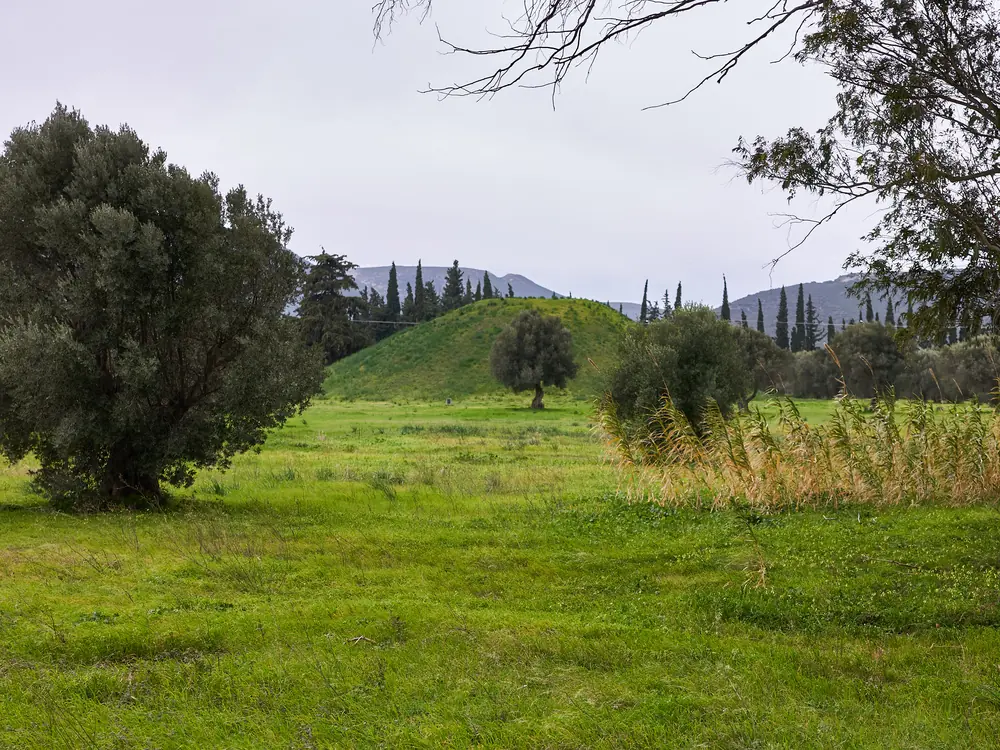
The tymbos, the burial mound raised over the 192 Athenian fallen, marked by a marble stele and set in a park. They were buried on the battlefield itself, which was an exceptional honour.
Μαραθώνας · East Attica
The mound over the Athenian dead of 490 BC is still standing, in a quiet park north of Rafina.
On 12 September 490 BC, an Athenian and Plataean force met a Persian landing on this coast. The Greek general Miltiades did something deliberate and risky with his line.
Schematic of the formation as recorded, not a survey of troop positions. The point it shows is the trade Miltiades made: match the enemy's width, and accept a weak centre to do it.
Herodotus' numbers: 192 Athenians and 11 Plataeans dead, against 6,400 Persians, with further Persian losses in the marshes. The Athenians and the Plataeans were buried in separate mounds on the battlefield, and an epigram by the poet Simonides was cut into the Athenian tomb.
The race is named after this place. The story behind the name is not the one in the guidebooks.
Everyone knows the story: a runner carries news of the victory from Marathon to Athens, gasps out "we have won", and drops dead. It is a wonderful story. Herodotus, our source for the battle, does not tell it.
What Herodotus describes is a different run, and a harder one. Before the fighting, a professional long-distance runner named Pheidippides was sent from Athens to Sparta to ask for help. That is over 225 km, and he is said to have covered it in roughly a day.
The famous version appears centuries later, in Plutarch and Lucian, who appear to have merged Pheidippides' run to Sparta with the Athenian army's forced march back to the city after the battle. The modern race commemorates a dramatic conflation of two real events rather than a single documented sprint.
None of which makes the place less worth visiting. It just means the mound is the real monument, and the story you were told is the later one.
The battlefield is the reason to come, but it is not the only thing on this stretch of coast.
The tymbos, the burial mound raised over the 192 Athenian fallen, marked by a marble stele and set in a park. They were buried on the battlefield itself, which was an exceptional honour.
The museum for the area holds what has been recovered from the battlefield and the wider plain. Hours and tickets change by season, so check the Ministry of Culture before setting out.
A reservoir, not a natural lake. The dam was built between 1926 and 1929 by the American firm ULEN, flooding around 10 km² of forest to supply Athens with water.
The long pine-backed beach southeast of the town, the best windsurfing spot near Athens, and home to the Olympic Rowing and Canoeing Centre built for the 2004 Games.
Full Schinias guide →For runners: Marathon is the start of the annual Athens Classic Marathon, and was the start of the Olympic marathon in both 1896 and 2004.
North along the coast. A car makes it easy, and pairs the battlefield with a swim.
We may earn a small commission from bookings made through links on this page, at no extra cost to you.
East Attica, at 38°9′12″N 23°57′43″E, north of Rafina up the coast. The municipality had 31,331 residents at the 2021 census, the municipal unit itself 10,063.
The mound and the museum take a morning between them. Schinias is on the same trip, so most people finish on the beach rather than driving straight back.
The other direction from Rafina gives you Vravrona and Porto Rafti, which pair with each other the same way.
The ones worth answering before you drive up.
Sunsets over the port, live ferry updates, hidden beaches and the food we can't stop eating — join the community on Instagram & Facebook.
 @rafinainfo